


Publications
![[Translate to Englisch:]](/fileadmin/user_upload/Presse_und_Medien/mediathek/YouTube-Vorschaubild/NOA-Namur-Open-Architecture-Connectivity.jpg "[Translate to Englisch:]")


14.10.2025
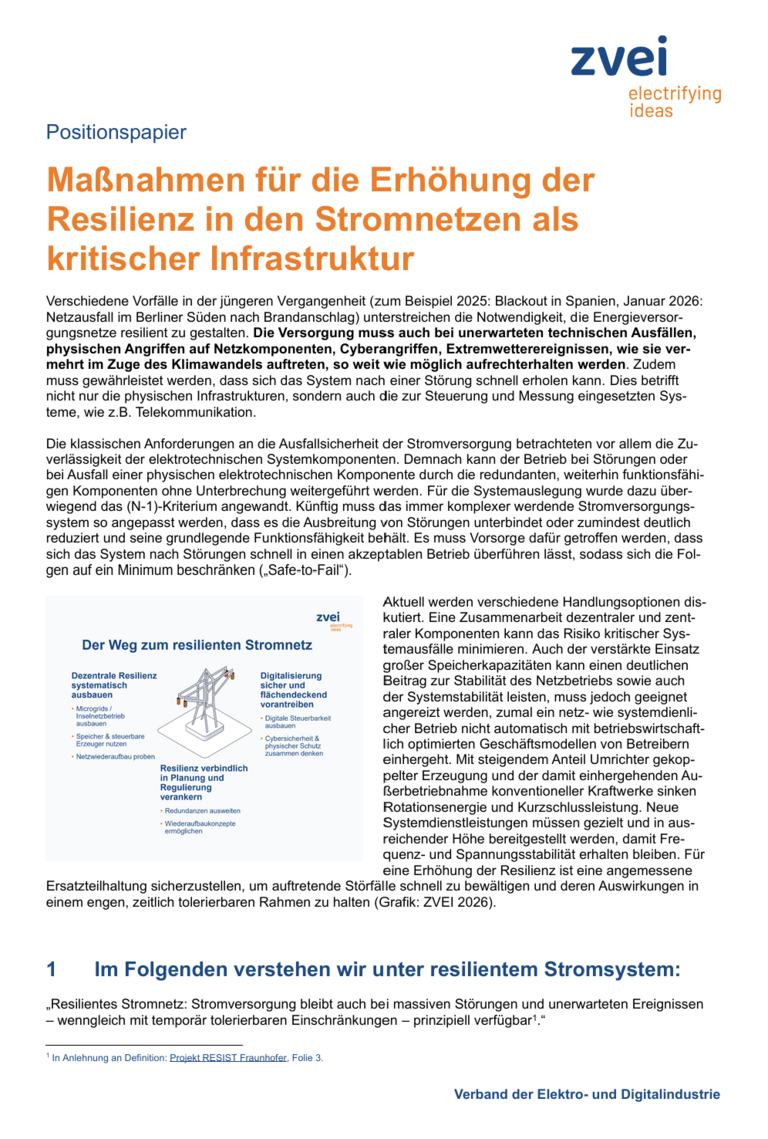
Technical failures, cyberattacks, sabotage or extreme weather can severely disrupt the power supply. The power system of the future must therefore do more than prevent disruptions: it must limit their impact, safe-guard critical functions and quickly return to stable operation.
Why do we need to rethink resilience?
As the energy transition progresses, the power system is becoming more decentralised, digital and complex. This creates new strengths, but also new dependencies. What is needed is a ‘safe-to-fail’ approach: even in the event of major disruptions, supply must remain available in principle – if necessary, temporarily with some restrictions.
What makes power grids more resilient?
Decentralised generation, microgrids and storage systems can temporarily safeguard critical facilities. Digitali-sation provides transparency and controllability. At the same time, physical redundancies, secure communica-tion channels, sufficient spare parts and forward-looking risk management are also essential.
What needs to be done now?
ZVEI sets out concrete measures for action in the short, medium and long term – from protecting critical grid users and ensuring secure digital infrastructure and scalable microgrids to building a resilient European power system. A structured dialogue between policymakers, regulators, grid operators and industry is crucial.